
Gender and women empowerment in the Comesa Region : opportunities and challenges
By Gaspard Maheburwa
Women occupy a special place in the development of the countries. Africa Gender Index reports that a new generation of young women are reaching adulthood better educated than ever before, and ready to play active roles in their communities, the economy and in national leadership. This is an opportunity to seize even if there are still many challenges to face.
The Declaration of the Platform for Action adopted in Beijing in 1995 remains an essential reference which marked a historic turning point in the fight for women’s rights and non-discrimination.
On October 31, 2000, the United Nations Security Council unanimously adopted Resolution 1325 on women, peace and security during Namibia’s UN Security Council presidency.
This resolution requires specific actions from women at the decision-making level in the prevention, management and resolution of conflicts. It targets the intervention of women and girls in all conflict resolution and peacebuilding interventions.
In Burundi , National instruments also exist to show the extent to which women’s empowerment figures on the points to be included on the country’s major agendas. These include, for example, decrees, laws and other texts consecrating the empowerment of women . The Country gender equality profile , 2023 Edition states 52% Female knowledge of laws promoting and protecting gender equality in Burundi.
Women can achieve more in COMESA
“I have been in construction for 30 years as a foreman. It was at least 10 years ago that I started seeing women come to me asking for work as mason’s helpers. I tell you frankly, if you want your project to move forward, recruit women. They are obedient and work with energy,” testifies François Ndabirorere, a foreman met on a construction site in the Nyabugete district at Bujumbura town hall.
According to Women Connect, an organization that campaigns for the empowerment of women, “Burundian women and girls participate in socio-economic recovery opportunities and benefit from various supports”. At the same time , pair learning from Comesa may help them to achieve more.
In all COMESA members , Women are determined to bring change in their communities. This is shown by their involvement in different countries.
Women Entrepreneurship in COMESA
The Government of Burundi has established a mechanism for the financial inclusion of women through the Rural Microcredit Fund (FMCR supported by UNDP). This provided in 2017 (according to the national evaluation report on the implementation of the Beijing declaration and action program, Beijing+25, published in May 2019) 45,559 jobs, including 32% in favor of women. In this way , Africa grew by an average of 4% in 2019, higher than the global average growth of 3.1% and more than double that of the European Union according to the COMESA Strategic Plan 2021-2025.
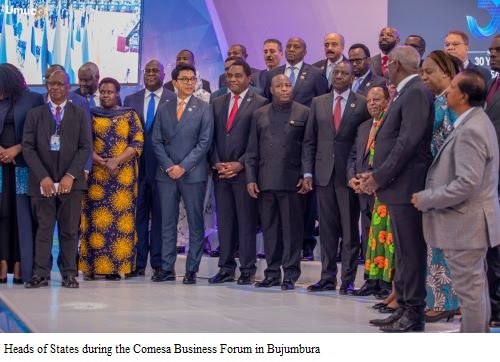
During the 17th COMESA Business Forum in Burundi in October 2024 , incredible women entrepreneurs from 9 COMESA Member States /COMESA Federation of Women in Business Chapters were taking center stage at this COMESA International Trade Fair. This shows the strengh women have at that level and can share experiences. They also serve as models for their young sisters.
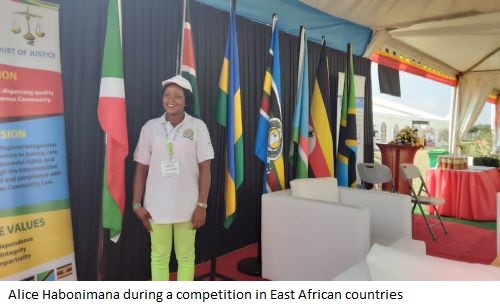
Alice Habonimana is one of the Burundian women business owners who have already been financed by NGOs. She has also gained the credibility of Embassies accredited in Bujumbura which often invite her for presentations at various events organized in Burundi. Alitom has also obtained several internship scholarships abroad.
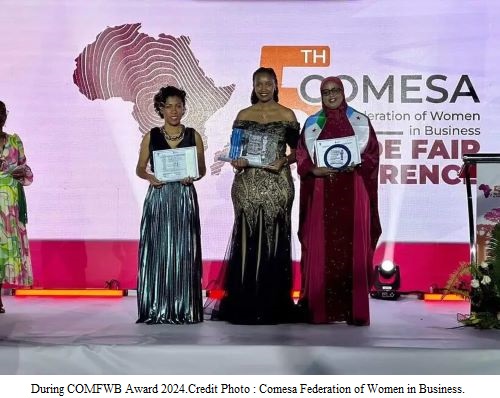
In June 2024, to honor Women Entrepreneurs from COMESA Region and recognize COMFWB Chapters efforts and achievements, COMFWB AWARD 2024 was organized last 28th and 29th June 2024. This is another good example that can inspire women in the COMESA Region to invest in Business . In fact , the COMESA Member States recognise that sustainable economic and social development of the region requires the full and equal participation of women, men and youth. Right from the formation of the Common Market, the Member States agree on the important role of women in the socio-economic transformation and sustainable growth process of the region and it is not possible to implement effective programmes for rural transformation and improvements in the informal sector without the full participation of women (COMESA, 1994- Article 154 of COMESA Treaty).
Facing Challenges and bringing Solutions.
COMESA , the largest regional economic body in Africa constitutes a third of the continent. By September 2022, the region counted 560 millions people and it is expected to reach 982.2 million people by 2043.
Data from various studies indicate that women and youth continue tolag behind in many areas of development including the sectors where the COMESA works.
In fact the COMESA Gender Policy shows major challenges women face such as in Trade where they are the majority atthe lower level with limited access to markets. In Agriculture ,they are the
majority small-scale farmers and in industry, they are those who cannot meet the standards to access markets with a limited access to Energy and ICTs,…
A study from World Bank indicates that in the African region in general, women who own small businesses tend to use informal means (family, friends, and the like) to raise capital for their businesses. This has long-term impacts on the size, profitability, viability, and sustainability of their business activities, ephasizes the report.
To face challenges related to economy , the Comesa Gender Policy takes measures about trade on pre-existing gender imbalances at the macro and micro levels that determine the differential impact of trade policies and agreements on women and men as employees, producers, service beneficiaries, tax payers and consumers. To sum up COMESA fully acknowledges that, although the majority of women are in the informal sector, women’s contribution to the promotion of investments and private sector development in theregion is significant and has the potential to exponentially grow.





Post Comment