
Professionals with disabilities in Burundi : When Stigmatized figures turn into community references
By Gaspard Maheburwa and Edouige Light Emerusenge
In Burundi, people living with disabilities have been stigmatized for a long time. The population being made up of between 15 to 20% disabled people, only 2% of these are recruited by various companies, according to a study. On a socio-professional level, they have long been frowned upon if not discriminated because of their physical conditions. However, even if there are still areas to correct, things have shifted into another world since those who have had the chance to be recruited by national or international organizations demonstrate unparalleled professional skills leading them by far to the status of role models. Discovery of these stars who are emerging in the professional sector in Burundi.
In the World, people with disabilities are more likely to experience a range of exclusion , including from employment , education ,healthcare access and social participation according to a study supervised by the Campbell Systematic Reviews.
In Burundi , for decades, it was not very common to find a disabled person in several sectors of professional lifein Burundi. From stigmatization to total refusal of access to key positions, people with disabilities have felt abandoned for several years in violation of the international convention on the Rights of persons with disabilities.
It’s true, we could see rare elements in certain sectors but not in professions making them more public. From 2018, the issue of people with disabilities has become a public one. Law No. 1/03 of January 10, 2018 on the promotion and protection of people with disabilities in Burundi is, certainly, a salient point in the consideration of people living with disabilities.
Unparalleled know-how…
Daniel Nshimirimana , whose Video report is here, is a blind journalist working for Radio TV Buntu in Ngozi. He is a holder of a Bachelor in Journalism. He had tried to seek a job in different local media but in vain.
“Every time I submitted an application looking for a job, I was told that there were none while the others continued to be hired,” testifies Daniel Nshimirimana. This media professional from Radio TV Buntu broadcasting from the province of Ngozi, in the north of Burundi, is one of the main journalistic figures of this sound broadcasting station. This TV radio has become a tourist spot. Visitors do not come to look at the tool. Rather, they come to see this brave person: a blind man who mobilizes the entire community around Radio TV Buntu. Burundians especially in Northern provinces had never seen a blind person working as a journalist. “If we want a well-read press release, we turn to Daniel,” specifies a journalist from Radio TV Buntu.
The Director who carried out his recruitment indicates that he experienced misunderstandings among the auditors but also towards certain members of the staff. But he had the courage to move forward even if some people called him crazy for recruiting a blind person into a press organization, something never seen before in any case. Comparative statistics before its arrival on the radio show that the number of subscribers on this station’s social networks increased by more than 50%. In fact, listeners saw him in broadcasts through radio on Facebook. Thus, the news spread very quickly in social circles.
“When he told me that he had a university degree in journalism, I couldn’t understand, because it was difficult for me to imagine how he was able to take journalism courses in his physical state,” says a journalist from the National Radio of Burundi.
This witness who met Nshimirimana in a journalists’ workshop in Ngozi warns: “Nshimirimana Daniel is a journalistic asset that the country must preserve. His talent is a dream for many.”
A civil society activist who participated in a competition in which another person living with a disability participated reveals a touching story. Moving around in a wheelchair without being able to stand, Saidi Niyongere is another icon living with a disability.
“He provides quality work and is excellent in terms of social diplomacy,” indicates Innocent Mugiraneza who was beaten by Saidi Niyongere during a competition to select the best projects to be financed by Burundi’s partners.
This talented youth organizer who directs the Coeur d’Amour Association in Burundi “Acabu”, active in radio soap operas and theaters, makes the headlines among professional references.
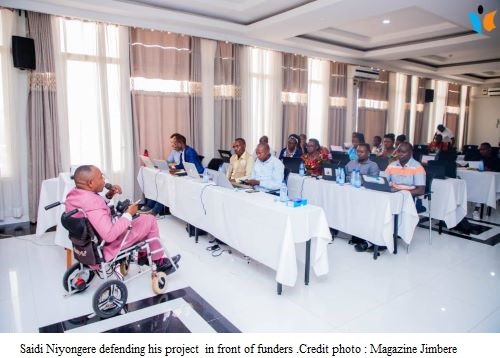
“Every time there is a call for projects, I have to submit a project on behalf of our association,” reveals Saidi Niyongere. Not only does he have exceptional know-how, this heavyweight in content creation has the ability to convince a partner who presents himself to him.
A fine writer of scripts for radio serials, he touches the hearts of thousands of listeners. A content creator by merit, Niyongere creates buzz in youth circles for whom he produces radio programs broadcast through several local radio stations.
This visibility is not limited only to men living with disabilities. Disabled women mark the professional difference as well.
Anne-Marie Nduwimana, widowed woman living with the disability of an amputated leg. She is a woman who carries out activities with her arms. She lives in Kamenge zone, Ntahangwa commune in Bujumbura town hall. Together with their associates, they take care of the daily work of sewing with the machine or by hand as well as other activities of manufacturing ornamental objects for women and girls, such as beads. They work in a sewing workshop for disabled girls” Hope” downtown Bujumbura.
“It is thanks to these activities that I survive because after having sewn the clothes or after having made these ornamental objects, I sell them and earn money which allows me to survive with my family”. She insists that even these pearls are sometimes made to order by customers who appreciate the quality of her products. What is also moving about Nduwimana is that it is she who takes care of her children’s school needs and their nutrition while there are other people who claim to be in good health but who are unable to cope get by in life.
Powerful determination despite the persistence of prejudices.
“During the first days, I was denigrated,” regrets G.Niyongabo, a journalist living with a leg disability and working in a press organ in Bujumbura. He takes stock of a situation he experienced where his colleagues asked an infinite number of questions: “What does this guy come to ? Will he be able to provide work? What are the recruitment criteria here?”
However, he emphasizes his determination which convinced everyone even if it took him time. “They had all gone on a work mission and I was left alone at the headquarters of our press organ. I was shocked but I was able to work anyway. When they came back and saw the quality of my work, they started to appreciate me positively.” Since this period, Niyongabo’s professional strength has stood out and he no longer cares about what others say because he is more than determined and became an inspiration for his colleagues.
This level of determination is also perceptible in Daniel Nshimirimana.
“My powerful umbrella to prevent those social perception’s, I tend to know my objectives, destiny and personal passion in my future dates. Regardless to my visual impairment, society likes judging a book by its cover, otherwise, disability is not inability at all. Moreover, those social perceptions push me to transform main obstacles into open opportunities in my life”, reassures Daniel.
As for Saidi, despite his very severe paralysis where we have to lift him every time if he is not on his handicap bike, he works. “Everything I have undertaken constitutes the source of my life, I live thanks to the activities I carry out. It’s not just me who makes a living thanks to these activities, others benefit too. This is why someone cannot say that he must be helped, but whatever his handicap, he must get up and work to develop and it is possible,” he insists.

Nduwimana, for her part, indicates that she works with people who also have disabilities but that they often collaborate, by exchanging services, with others who do not have disabilities. She affirms that this collaboration pushes them to become or treat each other like brothers and sisters without discrimination or exclusion. “This is done with the aim of supporting each other and allowing healthy people to also provide for the needs of their families,” she insists.
Challenges to be deplored
The Burundi Independent National Commission for Human Rights published a report in 2022 on the impact of COVID-19 on Children with disabilities with the Burundi case stated socio-economic upheavals caused by the pandemic are a reality. The problem is that children affected by the consequences of this illness may grow in this situation and this could bring other impacts on their lives including social stigmatisation.
According to our sources, the challenges depend on the type of disability. “Lack of adequate equipments for exercising my journalistic career. Techologies do not respond to my life status. I do not have computer adapted to blind men “, insists Daniel Nshimirimina. In this way of lack of adequate equipments , while going to toilet is a basic human need , it is , unfortunately , not always easy for many people especially during Climate change disasters and for those living with disabilities to find adapted toilets is a challenge acording to a report by Reliefweb .
Niyongabo evokes a workplace that does not help his state of health “We are on the fourth level of the building housing our house and that complicates my movements.” He also adds that he is sometimes assigned to mountainous fieldworks, which tires him too much.
According to Saidi Niyongere, the challenges are numerous. “Among the challenges, we are not understood by those around us. In addition, activity organizers do not take into account people living with disabilities. Especially when it comes to putting them in the institutions that make decisions and when it comes to building office buildings, they do not remember that there are people who cannot access everywhere or show information. stairs”, underlines Niyongere.
He insists that if they could build taking this situation into account, people living with disabilities could access everywhere, even on the upper floors using wheelchairs.
A study by the Association for the Promotion of the Rights of women with Disabilities in Burundi-Urumuri , states that people living with disabilities ,particularly women , are victims of insults or hurtful words , derogatory nicknmes , sexual violence, lack of decision-making power over family property , expropriation ,physical violence and exlcusion. This is another kind of challenges that prevent people ,especially women , with disabilities from development.
As for Anne-Marie Nduwimana, among the major challenges faced by people living with disabilities is that of moving. Indeed, this widow points out that it is difficult for them to get to their workplace by bus because it takes them a long time to get to the bus stop. And when they manage to reach the bus stop, once they arrive in town, it is difficult for them to travel to their workplace. This means they arrive late and spend little time at work. It’s the same scenario after work. They arrive home late at night.
Another challenge, according to Nduwimana, is that during exhibitions, there are times they are forced to pay people who help them lift goods. This means they lose the benefit they should have.
The president of the Association of University Leaders for the Promotion of the Disabled (ALUPH), Elicias Nzambimana, believes that people with disabilities should be recruited and facilitated in their work because excluding them is in some way an obstacle to development. In terms of travel, this Burundi State Lawyer affected at the Burundian Revenue Office ,says they are unable to achieve satisfactory output because their working hours are very minimal as they spend too much time on their way to job.
As we approach the electoral period in Burundi in 2025 , disabled people organizations are calling for the establishment of an electoral map dedicated to them. They specifically point out this category of community who must benefit from separate care in order to enjoy their rights as citizens . In fact , Burundi is a signatory to international agreements on people living with disabilities such as the Convention ( No 159 ) concerning vocational rehabilitation and employment ( disabled persons ). This is while the African Disabilities Year Book (2019) estimates at 1 806 624 people living with disabilities in Burundi.




Post Comment